

Close your eyes during a film and half the story disappears. Open them but mute the sound and you lose something even more essential. Music in film is the element that most viewers underestimate and most filmmakers fight hardest for — the difference between a scene that lands and one that soars is, more often than you’d think, three bars of the right melody at the right moment. These are the ten scores and soundtracks of recent years that elevated their films from good to unforgettable.
— — —
- Parasite (2019) — Jung Jae-il
The South Korean composer’s work for Bong Joon-ho’s film moves between drawing-room comedy and thriller menace with such seeming effortlessness that it’s easy to miss how technically sophisticated it is. The ‘Belt of Faith’ sequence — in which the Parks’ house floods while the Kims scramble to survive — uses its score to create a tonal vertigo that no dialogue could manage.
- Moonlight (2016) — Nicholas Britell
Britell’s chopped-and-screwed classical compositions for Barry Jenkins’ film created one of the most distinctive sonic signatures in recent American cinema. The way traditional orchestral music is pitched down and slowed creates something both intimate and epic — the sonic equivalent of the film’s visual language.
- Under the Skin (2013/rereleased influence) — Mica Levi
Mica Levi’s score for Jonathan Glazer’s film remains one of the most genuinely unsettling pieces of film music made this century. String harmonics, microtonal slides, a refusal to resolve — it makes the alien seem genuinely alien in a way that visuals alone couldn’t. Her subsequent work (Jackie, Spencer) has confirmed a major talent.
- Aftersun (2022) — Oliver Coates
Charlotte Wells’ debut film about a young woman revisiting memories of a holiday with her father is already one of the defining films of the decade. Oliver Coates’ score works in tandem with a carefully curated soundtrack of early 2000s music to create a specific texture of memory and grief. The combination of ‘Under Pressure’ and the score’s ambient drone is one of cinema’s recent great emotional ambushes.
- Blade Runner 2049 (2017) — Hans Zimmer & Benjamin Wallfisch
The legacy of Vangelis weighs heavily on any attempt to score a Blade Runner film, and Zimmer and Wallfisch met that challenge by leaning into it — massive, sub-bass rumbles, synthesiser architecture on a monumental scale. The score feels geological, appropriate for a film about a world slowly dying of its own weight.
- Her (2013/enduring legacy) — Arcade Fire & Owen Pallett
Spike Jonze’s film about a man falling in love with an AI was scored by Arcade Fire and Owen Pallett with such warmth and specificity that the music effectively becomes the third character. It never lets you forget how genuinely sad the film is, even in its moments of joy.
- Everything Everywhere All at Once (2022) — Son Lux
Son Lux managed to score a film of almost impossible tonal variety — genuine action film, absurdist comedy, and devastating family drama, often within the same scene — without ever losing coherence. The tenderness of the emotional climax is partly their achievement.
- Spencer (2021) — Jonny Greenwood
The Radiohead guitarist has become one of cinema’s essential composers, but Spencer may be his finest achievement. A score built on strings and saxophone that creates a portrait of disintegrating mental architecture — claustrophobic, occasionally beautiful, always on the edge of breaking.
- Dune (2021) — Hans Zimmer

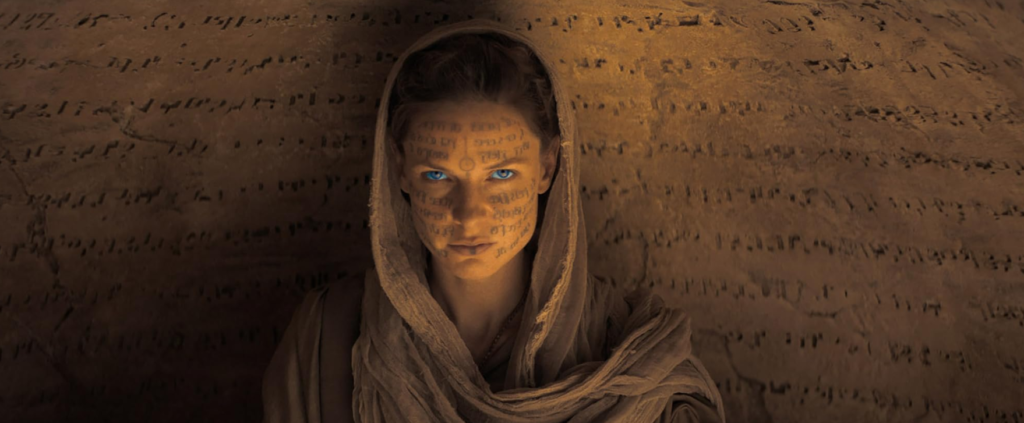
Zimmer rebuilt his entire compositional vocabulary for Denis Villeneuve’s adaptation — creating new instruments, new textures, new sounds that feel genuinely alien while remaining emotionally intelligible. The opening titles alone constitute one of cinema’s recent sonic masterpieces.
- The Power of the Dog (2021) — Jonny Greenwood
Greenwood appears twice on this list because the level of his recent output demands it. His score for Jane Campion’s revisionist Western is built around the banjo — the instrument Phil Burbank uses to assert and conceal himself — in a way that makes the music inseparable from the character study.
— — —
The next time you watch a film and find yourself moved, pay attention to what’s happening with the music. In almost every case, it’s doing more than you realise — building emotion, undercutting it, complicating it, or simply insisting on it. It is cinema’s secret language.