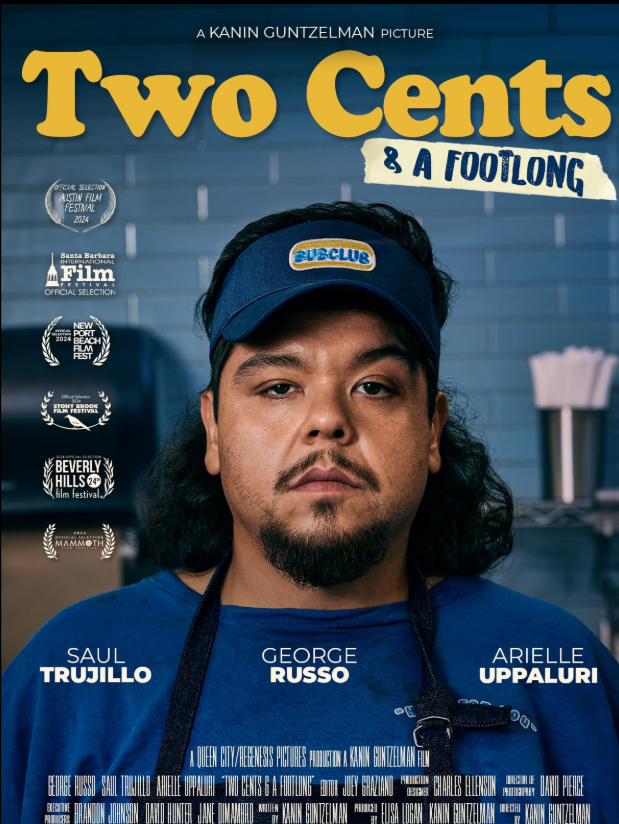
Kanin Guntzelman’s Two Cents & A Footlong is a masterclass in “location-based” storytelling. As a short film, it operates with a surgical precision, proving that you don’t need a massive budget or a globe-trotting script to hit an audience where it hurts. All it takes is a fluorescent-lit 24-hour sandwich shop at 4:00 AM and two guys at completely different ends of the emotional spectrum.
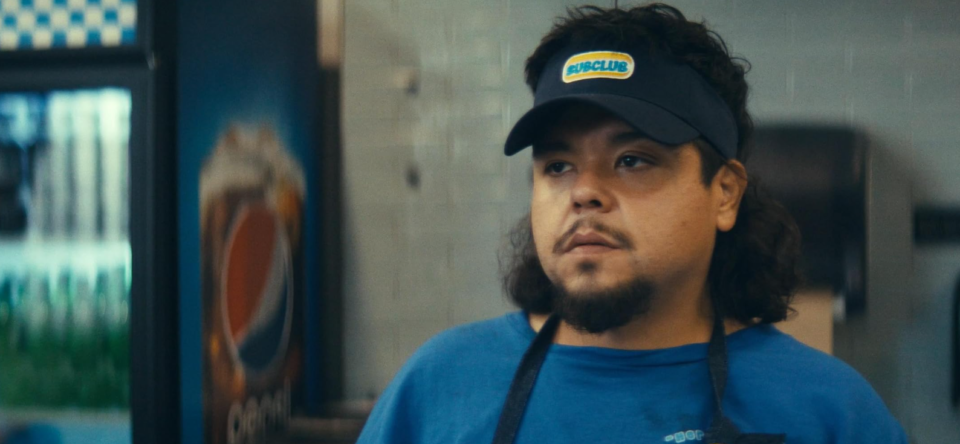
The film introduces us to Lenny, played with a perfect, blue-collar amiability by Saul Trujillo. Lenny is the guy behind the glass, the gatekeeper of the late-night footlong. His world is predictable until Roger (George Russo) stumbles in. Russo’s performance is hauntingly raw; he’s playing a man whose insomnia isn’t just a lack of sleep, but a symptom of a much deeper, existential rot. He isn’t just placing an order; he’s barely holding it together.
The tension shifts from “customer service” to “soul-searching” almost immediately. Lenny asks a seemingly throwaway question: “Are you happy? In the grand scheme of things.” It’s the kind of inquiry that usually gets a “sure” or a “can I just get my sub?” response. But for someone like Roger, who is teetering on the edge of despair, it acts as a total system failure.
What follows is a brutal unloading of burdens. The film dives deep into the themes of loneliness and the sheer unpredictability of our internal struggles. Guntzelman manages to make the dialogue feel heavy and earned, avoiding the “pseudo-philosophical” traps that many short films fall into. When Roger starts pouring out his existential crisis, you aren’t just watching a scene; you’re witnessing a man drowning in plain sight.
The dynamic gets even more complicated when an elegantly dressed woman enters the shop, likely on her way home from a high-end night out. Her presence serves as a sharp contrast to Roger’s disheveled state, yet the film subtly hints that she’s carrying her own baggage.
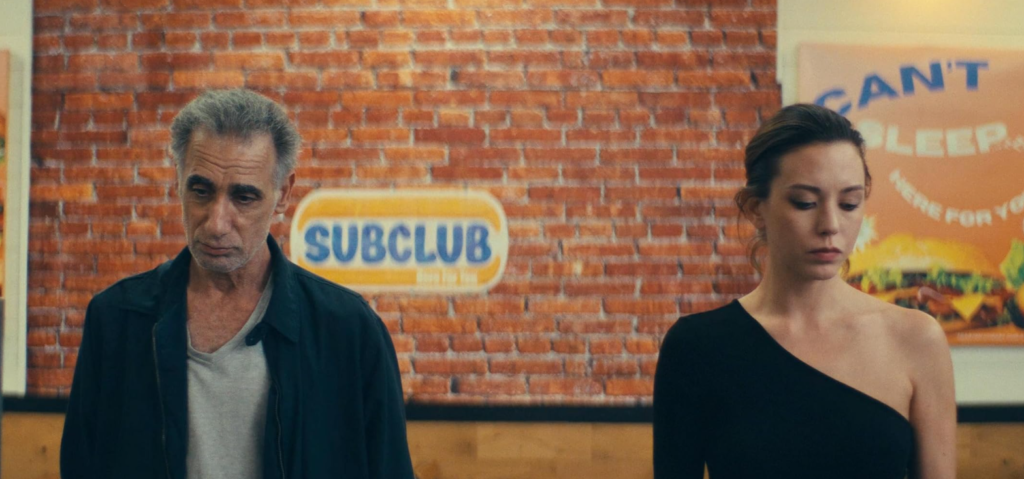
The turning point comes when Lenny trying to maintain a semblance of professional normalcy attempts to dial back Roger’s oversharing to protect the new customer’s comfort. It’s a move that triggers an eruption of frustration from Roger. That moment of tension is palpable. It showcases the film’s ability to navigate the complex nuances of human connection: how we seek it out, how we push it away, and how fragile it really is.
From a technical perspective, the production design is top-tier. Even though we’re confined to a single shop, the environment feels totally immersive. The attention to detail in the condiment station and the prep area is so spot-on that it actually triggers a physical response. I’ll be honest watching this made me genuinely crave a sandwich.
The title Two Cents & A Footlong is a clever bit of wordplay. It highlights the “cheapness” we often assign to human interaction (the “two cents”) versus the mundane, transactional nature of the setting. It’s a reminder that the most life-altering moments usually happen in the most ordinary places.
While I think these themes are ripe for a feature-length expansion, there’s an undeniable power in the short format here. It’s a poignant reminder to value those fleeting moments of empathy. More importantly, it pushes a “keep moving” philosophy—the idea that no matter how dark the 4:00 AM hour gets, you have to stay in the game because you never know when the light is going to shift.
For its tight storytelling, gritty performances, and the way it manages to make a sandwich shop feel like a high-stakes arena, Two Cents & A Footlong is a rare find that stays with you long after the neon signs turn off.
Next time you’re at a late-night spot, take a look at the person behind the counter or the stranger next to you. Everyone’s got a story, and most of them are heavier than you’d think.