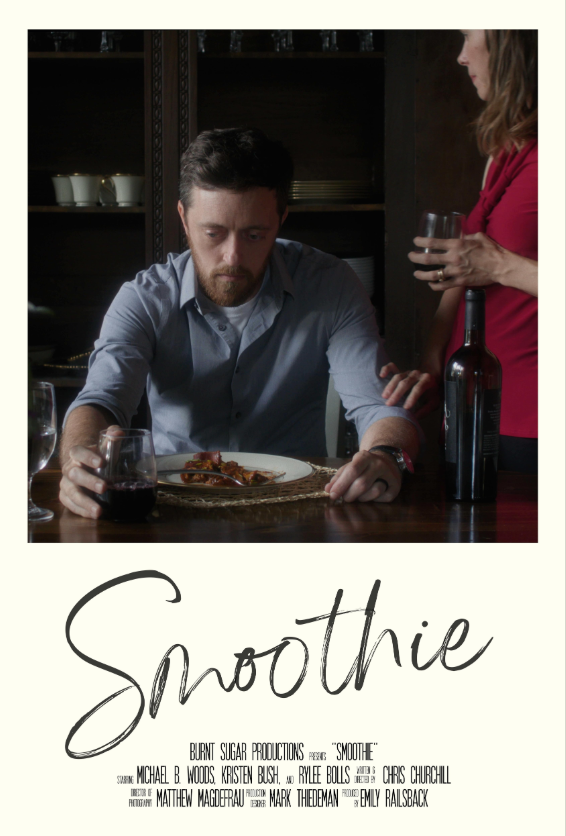


The synopsis for Smoothie is a textbook example of “suburban noir.” It takes a familiar, cozy archetype the stay-at-home dad and immediately injects it with a toxic element. What makes this premise particularly sharp is the power dynamic shift. Usually, an infidelity plot involves a spouse or a private investigator, but by using the daughter’s best friend, Churchill creates a unique form of leverage. Lily represents a bridge between John’s domestic sanctuary and the outside world he’s been caught in. It’s concise, evocative, and promises a high-tension chamber piece where the stakes are purely psychological.
There is a specific kind of tension that can only exist in a quiet, sun-drenched kitchen. It’s the sound of a blender whirring, the rhythmic thud of a knife hitting a cutting board, and the terrifying realization that your life is about to shatter. In Smoothie, writer, director, and editor Chris Churchill takes these mundane suburban sounds and turns them into a ticking time bomb.
Early on, it’s actually a bit difficult to pin down exactly what kind of movie Churchill is making. Is this a slice-of-life drama? A quirky character study? That ambiguity turns out to be the secret sauce. By refusing to show his hand too early, Churchill forces us to live in the same uncomfortable headspace as his protagonist, John.
Michael B. Woods is perfectly cast as John, a man who, on the surface, is the blueprint for the modern stay-at-home dad. He’s dependable, domestic, and seemingly content. But the arrival of Lily (Rylee Bolls), his daughter’s best friend, changes the temperature of the room instantly. What starts as an innocent, albeit unexpected, visit quickly devolves into a high-stakes interrogation. Lily isn’t there for a snack; she’s there with a grenade. She spotted John the night before with a woman who definitely wasn’t his wife, and she’s not keeping that information to herself.
What follows is a masterclass in restrained drama. Rylee Bolls is incredible as Lily, playing the role with a chilling level of confidence that feels far beyond her years. She doesn’t scream or throw accusations; she simply lets the truth sit on the counter like the fruit John is slicing.
The tension reaches a fever pitch when John’s wife, Annie (Kristen Bush), finally walks through the door. This is where Churchill’s “patient uncoiling” really pays off. As viewers, we are left suspended in a state of mounting uncertainty. We’re watching the subtext play out in real-time—the glances, the forced smiles, and the heavy silences that say more than any monologue ever could.
Churchill’s choice to leave us with more questions than answers is a bold one, but it fits the “elusive truth” at the heart of the film. He isn’t interested in giving us a tidy moral lesson or a dramatic blow-up. Instead, he wants us to sit in the discomfort of a lie that hasn’t quite broken the surface yet.
With stellar performances and a visual style that feels both intimate and slightly voyeuristic, Smoothie is a haunting reminder that the most dangerous secrets are often hidden in the most “normal” places. It’s a lean, smart, and deeply unsettling short that proves Churchill is a filmmaker who knows exactly how to make his audience squirm.
The final shot, it’s a haunting exclamation point on a story that refuses to let you off the hook.

3/5