

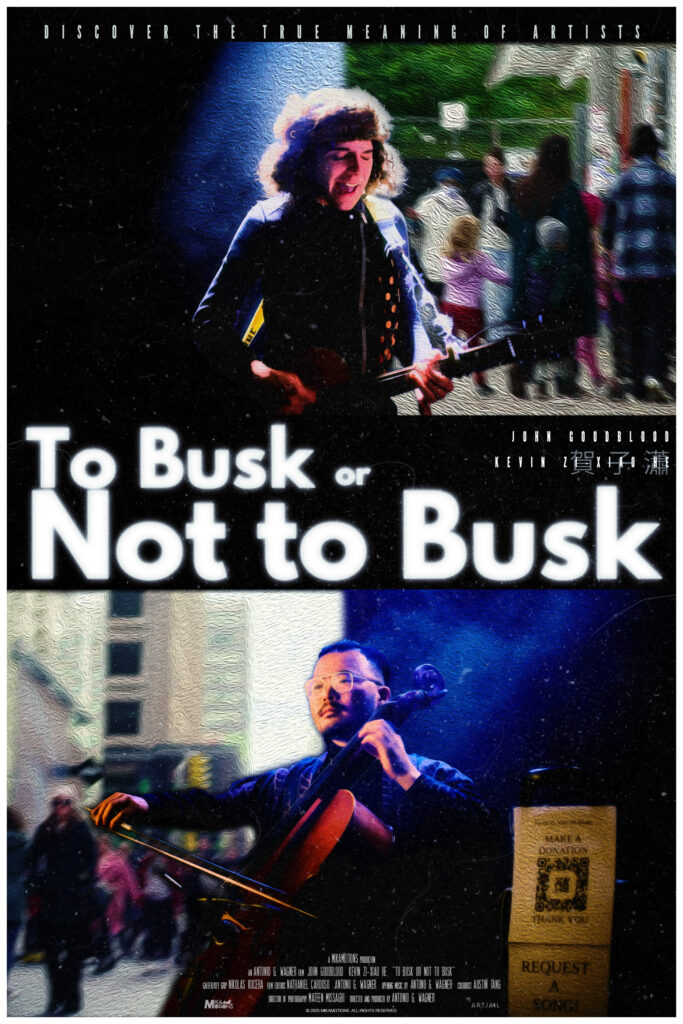
For most people grinding through the daily hustle of busy city streets, buskers are just background noise heard for a split second, but rarely truly noticed. But for filmmaker Antonio G. Wagner, street musicians represent something a hell of a lot deeper: they’re artists chasing raw connection, personal fulfilment, and emotional truth in its purest, most unfiltered form.
In his short documentary To Busk or Not to Busk, Wagner dives straight into the emotional and psychological grit of street performance, tracking the real-world experiences of immigrant musicians John Goodblood and Kevin Zi-Xiao He. What he delivers isn’t just a film about music; it’s a heavy, deeply personal reflection on artistic courage, sacrifice, and the brutal, everyday tension between creative passion and financial survival.
In this chat, Wagner opens up about the raw inspiration behind the doc, the grind of independent filmmaking, and why he firmly believes street performers deserve the same respect as musicians packing out the world’s grandest arenas.
- Antonio, can you tell us about your filmmaking journey and what first inspired you to pursue this as a career?
Antonio: From a young age, I became aware that my ultimate source of excitement and motivation in life mainly came from films. At the same time, I’ve always felt a need to inspire viewers with stories in the visual medium that offer unique perspectives on familiar subject matter, and I’m not satisfied until an idea I start developing is brought to life. However, wanting to pursue directing comes with an uphill battle while still being able to make a living. Thus, I had no other choice but to hustle on making strong connections where we could help each other grow, along with embracing my limitations for each project I make, which hasn’t stopped my desire to create art.
- What was the moment when you realized that busking would make a compelling subject for a documentary?
Antonio: Yeah, at first, it’s the topic you hear about, and there’s already a stereotypical way of perceiving the busking profession. That’s exactly why it was the perfect subject to make a documentary on, since I had an opportunity to execute the film in a unique manner that would flip this perspective and have viewers build a stronger appreciation not only for the value of buskers, but of artists in general. That, along with some personal ties of mine to the film’s themes. Ultimately, realising I could make seeing an orchestra and a street musician perform feel interchangeable, it became a commitment part of the film’s takeaway to fulfil.
- Would you say that your own relationship with music has influenced the stories you choose to tell?
Antonio: For sure, since I find the specific use of sound and music in media to be so crucial for the viewing experience. This might not apply to other filmmakers, but I’m someone who can never imagine making something without music being a part of it. It depends if it fits your approach to telling a story, but I’m drawn to enhancing stories with music. Also, as the composer and re-recording mixer of the film, I’m picky about what music to use and how all the sound elements should be mixed together. This film is a clear example of that, about showing how music can have the same impact regardless of what venue it comes from.
- The title ‘To Busk or Not to Busk’ immediately evokes an internal conflict. What does that question ultimately mean to you?
Antonio: Well, first I’d like to thank Shakespeare for the inspiration, but ultimately it’s the title that perfectly reflects the film’s intentions. Specifically, from our two subjects coming from different backgrounds, who each provide their own unique views on the pros and cons of busking consistently. However, it’s a question I often have stuck in my mind, if pursuing the arts without financial certainty worth it? I try to find a balance. Visually showcasing both the practical and psychological perspectives of each subject was a way for viewers to be put in their headspace with these two opposing thoughts, causing a change in their worldview.
- John Goodblood and Kevin Zi-Xiao He are from very different musical What made them the ideal subjects for this film?
Antonio: The film was always envisioned to be told by different buskers to leave viewers with a broader understanding of the profession through a wide variety of perspectives. Otherwise, if you had different subjects that provided the same personality and comments, it would just make the stories feel repetitive. These two already represented a perfect yin and yang dynamic from seeing them perform, but hearing their interviews only solidified that claim. The film’s concept is also best suited in a short format, so only having two subjects was perfect since it gave them each enough screen time to leave an impression with their interview and performance.
- Also, both musicians are immigrants. How important was the immigrant experience to the documentary’s broader narrative?
Antonio: Honestly, the execution of the film wouldn’t make much of a difference if they weren’t immigrants. However, the fact that they are adds an extra layer to connecting with the subjects, based on how their music stories from their origin countries affect their motives/way of thinking nowadays. Especially for John Goodblood, whose fascinating immigration story resulted from meeting his Harm & Ease band members while busking in Argentina, which led him to immigrate to Canada with them and become the Juno-nominated artist he is today.
- One of the recurring themes is the idea of artistic legitimacy. Do you feel society still places street performers lower than touring or concert artists?
Antonio: I mean, considering that one of the inspirations on making the film was being someone who constantly ran into buskers in urban cities and saw how people in a rush would stop and feel euphoric with their music, but they would fail to express their gratitude or leave any kind of compensation. Also, how non-musicians in my life react when mentioning buskers, there’s a general low-value way of perceiving them. I hope this film is able to change this perception by providing it with the largest exposure possible.
- Were there any moments during production that challenged your own assumptions about art, success, or creative fulfilment?
Antonio: Given the minimal resources and hustling that had to be done in order to produce the best film possible, similar to my subjects, I started questioning my own intentions of pursuing art full-time. It’s the kind of path where complete devotion to independent projects can get in the way of opportunities that provide financial security. However, similar to the buskers who were willing to keep performing outdoors during cold winters when we filmed them, one’s unique vision for art is worth fighting for. My goal is to find fulfilment in my productions while exploring opportunities to expand my skills and monetise my work to provide for myself.
- What surprised you most while spending time with buskers and observing their interactions with the public?
Antonio: This might not apply to every busker, but I was surprised by their full devotion to the profession that puts them at the risk of daily uncertain income. Both subjects have grander careers in music than just busking, but music is mainly what they dedicate their life to, and they wouldn’t want it any other way. This would be more common for John Goodblood rather than Dr Kevin Zi-Xiao He, who sees busking more as a weekend hobby and not a daily routine. Also, witnessing some unique spontaneous audience interactions while filming their performances made me witness how humbly they engage with their community.
- Can you share with us what a film like this cost you to make? Did you have a budget limit in mind, or did you finish the film before realizing how much it cost you to make?
Antonio: For this kind of project with an ambitious presentation, it normally would result in a much higher budget than what it was made for (which was around $1,000 USD). I must give credit to my crew’s persistence, my former university’s facilities, and my exceptional director of photography, Mateen Missaghi, who provided his own camera bundle and gear that helped minimise our expenses. All of these factors allowed us to produce the film within our financial means. The shoot could’ve been more convenient with more capital, but the end result turned out better than what was envisioned, and a higher budget wouldn’t have affected its quality.
- Lastly, looking back now, what did making this film teach you about courage as an artist?
Antonio: After the entire process of assembling the film against all odds and presenting the finished product to an audience in its intended format, this showed me what it meant to have courage, certainly one of the defining traits of an artist. For those who feel a dependency on making specific art to provoke emotions, and not letting fear of public perception stop them from making it. Growing up, I used to be someone who got scared to expose myself for overthinking how I’d be perceived. Over time, I discovered to be proud of my own voice and wanting to share it with the world, and this film, along with more I’m aiming to make, is a reflection of that.
What hits you hardest when talking with Antonio G. Wagner is that To Busk or Not to Busk is just as much about the man behind the camera as it is about the musicians in front of it. Beneath the dialogue about street performance, artistry, and public perception lies a young director wrestling with the exact same heavy questions keeping his subjects up at night: Is bleeding for your art without a safety net actually worth the sacrifice?
How much grit does it take for an artist to protect his voice? Built on pure persistence, collaboration, and sweat equity rather than a big-budget bankroll, Wagner has forged a documentary that forces audiences to re-evaluate not just how they view street musicians, but how they value art itself.
And that’s the film’s real win. Reminding us that true artistry isn’t defined by a high status, a luxury venue, or industry validation, but by having the balls to stand up and share something completely honest with the world.