

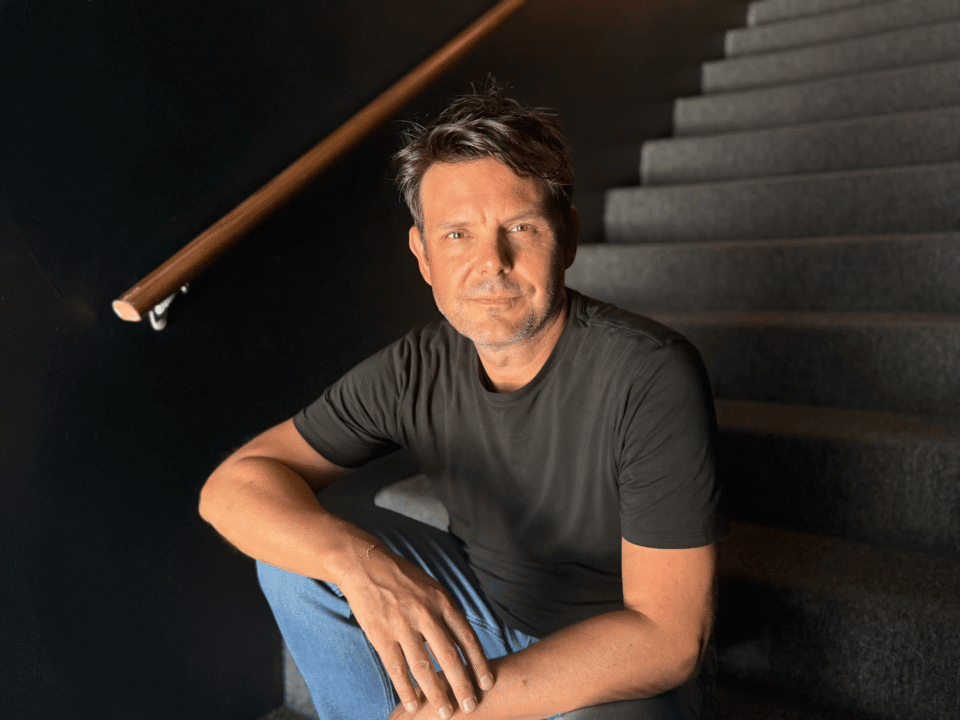
Hamish Sturgeon’s artistic path first bloomed on stage as an actor, but ‘Gossamer’ beautifully reveals a director whose heart is captivated by what lingers beneath the surface. His gentle work behind the camera, deeply informed by his years as a performer and acting teacher, reflects a fascination with the soft, protective masks we wear, and the vulnerable pieces of ourselves we hide just to survive in this world.
In Gossamer, that quiet curiosity blossoms into an intimate, breathtaking exploration of grief, identity, fear, and tender acceptance. Told through a subtle, elegant visual language, the film softly trusts its audience to observe rather than be led by the hand.
In this warm interview, Sturgeon opens up about the deeply personal questions that sparked the project, the poetic meaning behind its fragile title, the whirlwind challenge of capturing magic independently in just three days, and why learning to surrender control and trust your collaborators is the most beautiful part of the creative process.
- Hamish, can you tell us briefly what your journey into filmmaking has been so far?
Hamish: I came to filmmaking through acting. I’ve also taught acting for many years and I’m the Creative Director of the Margie Haber Studio in Los Angeles. A huge part of my work has been helping other actors find truthful behavior and guiding them moment to moment, so in many ways I had been developing the instincts of a director long before I actually called myself one.
- Your film ‘Gossamer’ explores grief alongside identity and acceptance. What inspired you to make a film about these themes?
Hamish: I’ve always been interested in identity, and particularly the stories we create about ourselves in order to survive. I often find that what people hide is the most interesting thing about them. Who we are in private, without the eyes of the world watching us, reveals so much about our character. I think about that a lot when I’m creating characters, but also, if I’m honest, when trying to understand myself.
- The title evokes something delicate and almost intangible. What does the title represent to you, and when did you know it was perfect for this film?
Hamish: There’s something beautiful about the word itself. It has a softness and lightness to it that contrasts with some of the darker emotional territory in the film. It’s a spider’s web that holds and traps, and it’s also delicate and ephemeral. It just came to me when faced with a blank page. I think it’s the first word I wrote. I don’t remember seriously considering another title. It just seemed to contain the film somehow.
- Much of the film seems to rely on what remains unsaid. How do you decide when silence can communicate more powerfully than dialogue?
Hamish: The camera is incredibly good at detecting thought. If the internal life is there, you don’t always need to give it words. In fact, sometimes dialogue can diminish a moment by explaining something we already understand simply by watching someone experience it. I was very lucky with Natalie Mitchell, who plays Shirley, because she understood that instinctively. So much of Shirley’s journey happens without dialogue, and Natalie was able to let us see her thinking without ever feeling the need to show us what she was feeling.
- Your protagonist is wrestling with both loss and self-discovery. How did you ensure those internal struggles felt authentic without overexplaining them?
Hamish: Jack is struggling with agoraphobia, gender dysphoria and loss, and somehow, I had to trust the audience to understand all of that without having him explain it. He’s dealing with an enormous internal struggle while, externally, the world is approaching and threatening to break in. The house is his safety, but it’s also his prison. That dichotomy was interesting to me.
- Were there any limitations or challenges you faced that ultimately made this film stronger?
Hamish: Absolutely. We shot the film in three days on an independent budget, so there was very little room for error. But limitations force you to make decisions. You can’t shoot everything from every possible angle and decide what the film is later. You have to know what matters. Jesse Aragon, our cinematographer, and I had to be very specific about where we placed the camera and what each shot was doing emotionally. We shot only in one location with really helped set the world up quickly.
- Visually, the film appears intimate rather than expansive. How did you and cinematographer Jesse Aragon develop a visual language that reflected the protagonist’s emotional state?
Hamish: Jesse and I talked a lot about art and shared images and inspirational pieces that helped us understand what the visual world of the film was going to be. We wanted the camera to feel close to the characters without the filmmaking itself ever feeling intrusive.
Jack is emotionally contained for much of the film, so we didn’t want a visual language that was constantly telling the audience what to feel. We wanted to observe Jack and Shirley closely, and at times I wanted it to feel as though we were watching them through a goldfish bowl almost, close enough to see everything but still separated from them.
- Also, how did you approach the editing process to preserve the film’s emotional rhythm without losing the subtlety that defines it?
Hamish: Editing was also difficult for me because, as the writer and director, I was attached to so many moments that I loved individually. Stephen Lambriodes was very good at helping me let go of things that might have been beautiful on their own but weren’t necessarily serving the film as a whole. That’s a hard lesson to learn. Sometimes you have to lose something you love in order to make the story stronger. Because so much of Gossamer exists in looks, pauses and reactions, we had to resist the temptation to constantly accelerate things. At the same time, subtlety doesn’t automatically mean slow.
- As someone who comes from an acting background, were there moments during filming where your instincts as an actor conflicted with your instincts as a director? How did you navigate those situations?
Hamish: Preparation was the answer. I surrounded myself with people I trusted, which allowed me to relinquish some control when I was acting. I also learned very quickly that I couldn’t direct myself while I was doing a take. At some point you must stop evaluating and simply be the actor and then step back out and become the director again. It was challenging, but being inside the film also gave me an unusual intimacy with the material. There was something quite freeing about not having the luxury of overthinking my own performance. I probably did less takes for me than anyone else.
- Lastly, as an independent filmmaker, what lessons from making ‘Gossamer’ will you carry into your future projects?
Hamish: The biggest lesson is probably to trust simplicity. You don’t need endless resources to tell a meaningful story, but you do need clarity about what story you’re telling and why you’re telling it. I learned just how important collaboration is. You begin with something incredibly private, an idea that exists in your head or on a page and then you invite all these talented people into it. The crew are everything. Without them, you don’t have a film. So be very intentional about who you bring onto a set. It has to be a collaboration built on trust and mutual respect, where everyone feels that they’re contributing to the same story.
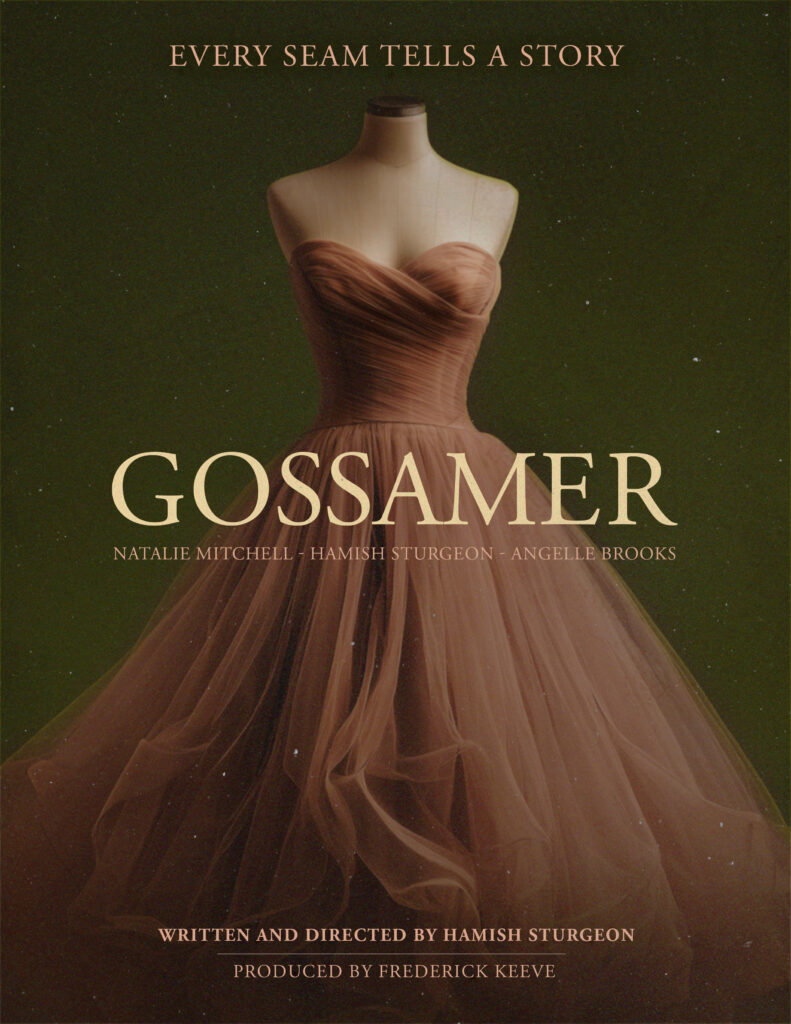
When the final frame fades, Gossamer feels like so much more than a simple short film; it is the soft opening line of a creative romance Sturgeon plans to carry across both cinema and theatre. His reflections radiate the quiet wisdom of a storyteller who realises that true impact doesn’t demand grand spectacle, only clarity, raw honesty, and the courage to strip away the excess.
From letting poignant silences breathe to gently letting go of a favourite scene for the sake of the story’s soul, bringing Gossamer to life has clearly anchored his faith in simplicity and shared passion.
Ultimately, both the film and Sturgeon’s own artistic evolution lead us back to the same sweet, fundamental truth: that beneath the brave faces we show the world, we are all just fragile, complicated human beings yearning to connect, to be loved, and to be truly seen.