

There’s a rare, undeniable power in a filmmaker who can take a bare-bones concept and use it to strip human nature down to the bone. Jack Serra does exactly that with his sharp, uncompromising short film, ‘Luxor’.
What starts as a simple, high-stakes gamble over a lottery ticket rapidly mutates into a darkly funny, relentless autopsy of addiction, desperation, and the sheer madness of the obsessions we chase. Dusting off a raw concept he first cooked up as a teenager, Serra rebuilds and sharpens the narrative into a heavy, multi-layered story that backs you into a corner with tough questions about human weakness—all without losing its dark, razor-sharp edge.
In this interview, Serra gets honest about the roots of Luxor, the real-world experiences that fueled its central themes, the delicate balance of mixing dark humour with moral grit, working with an eclectic cast, and why the relentless grip of addiction remains the ultimate driving force behind his cinema.
- What was the initial spark that inspired your latest short, ‘Luxor’, and at what point did you realise it was a story you needed to tell?
Jack: It actually came from a couple of places, but the biggest inspiration was a short film I made back in 2016 when I was about 15 years old. It was about a man who wins the lottery, chokes on a bag of chips while movers are in his house, and suddenly they’re left with this moral dilemma over whether they should keep the winning ticket. I always thought there was something interesting buried in that premise, so years later I revisited it and reimagined it in a setting that felt more grounded and relevant today. Once I started expanding the characters and exploring the different forms of addiction and desperation that can drive people, it became a much richer story than the original.
- You chose an interesting title for this film. Why was ‘Luxor’ the perfect title for this story?
Jack: I wish I had a better answer to that. I always thought the word sounded cool and that it’d make a good title for something. I had it sitting in my notes for probably the last five years, but I never had anything to use it for. When I was writing this, attaching it to the fictional lottery just felt right, and that’s where it landed.
- Your film balances serious themes with dark comedy. How important was it for you to keep this balance, and how did you achieve this?
Jack: Yeah, again, that’s where the absurdity of the original idea blends with this more serious course of events. It’s hard to navigate, and you never really know how it’s going to come off to somebody else. But all you can do is know the outcome of your story and keep that in the back of your mind throughout every other sequence.
- Nearly every character seems driven by desperation in one way or another. How important was it for you to avoid portraying anyone as purely good or evil?
Jack: I like to think every character is kind of a victim of their own vice. Victor’s a serial slacker, Anne has the lottery, the little boy can’t stop watching EJ’s streams, and for EJ, streaming is maybe his addiction in itself. Everyone is kind of a slave to their own vice in this film, and I think that makes them pretty empathetic. I definitely didn’t want anyone to come off as purely evil, although EJ probably doesn’t have enough screen time to be perceived as much else.
- One of your film’s underlying themes is addiction, and you have described it as something that extends far beyond substances. What made you want to explore that idea through cinema?
Jack: Addiction is something I’ve battled with for my entire adult life, and it seems to be a recurring theme that I keep coming back to. I love to comment on it and give my own perspective. If there’s one overarching theme in my narrative work so far, it’s addiction. I think there’s something to say about that.
- What were some of the biggest creative or logistical challenges in bringing Luxor to life?
Jack: I wouldn’t say it was as much of a challenge as it was interesting to work with both Jenny O’Hara, who comes from a more traditional Hollywood background, and Jack Michael Ryan, who’s part of this younger generation that’s making a name for itself online. To have those two sit down in a room together and act out a scene was really interesting. They had two very different outlooks on it, and it was fascinating to watch how they maneuvered around each other. Ultimately, I think we got a great performance out of both of them.
- Were there any visual or cinematic influences that shaped the film's aesthetic and storytelling?
Jack: Visually, we were pretty inspired by ‘The Killing of a Sacred Deer’. The composition in that film is so interesting, and we definitely looked to it as a reference. In terms of tone, we were aiming for something closer to ‘Barry’. That balance between humor and violence is something we really admired and wanted to capture in our own way.
- Lastly, this certainly looks like a story that has the potential for a feature-length exploration. Is it something you are considering? Or what other human behavior are you eager to explore in future projects?
Jack: The ending is left pretty open, so there’s always a world where we explore it further. But for the most part, I like how contained the story is. I think you get what you need out of it, and the rest can be left to your imagination. Addiction is something I’ll definitely continue exploring. I think the darkly comedic tone will be something I stick to as well.
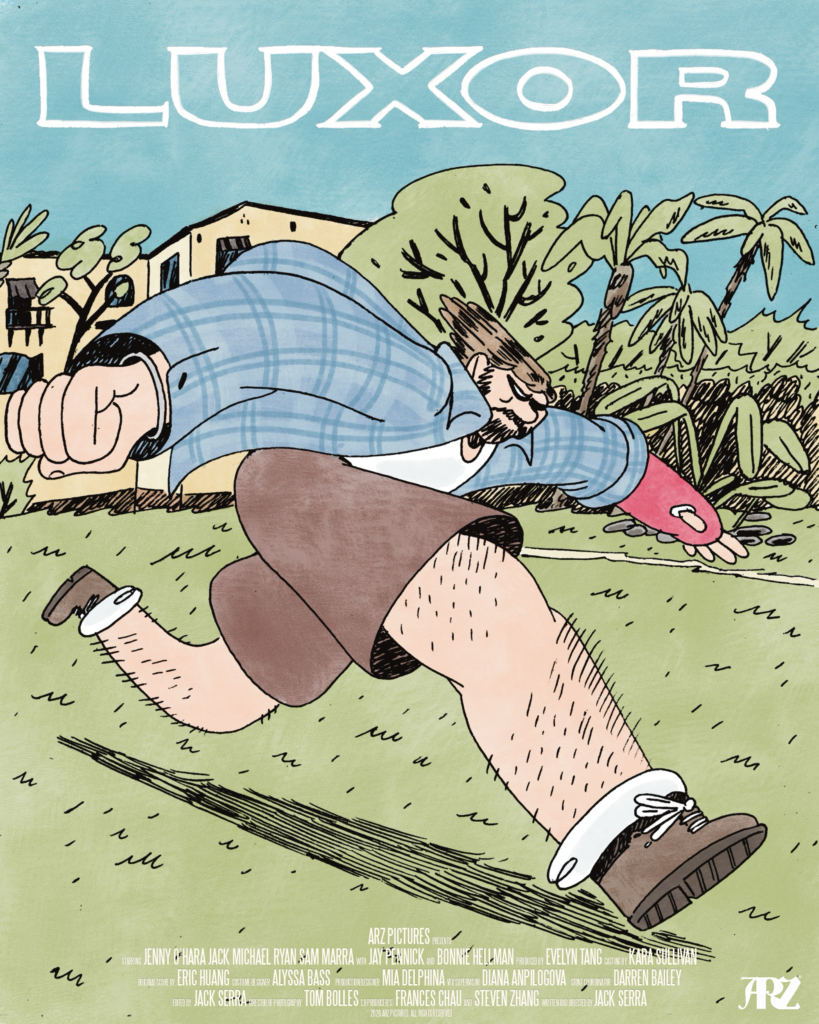
‘Luxor’ might refuse to hand you a tidy resolution. Still, Jack Serra is more than comfortable letting the audience sit in the quiet aftershocks, knowing that the realest stories are the ones that keep pounding in your head long after the screen goes dark. His absolute fixation on addiction not just as a substance trap, but as the quiet, insidious obsessions that control every aspect of modern life is the unapologetic core of his creative identity, and he’s just getting warmed up.
Armed with a dangerous mix of pitch-black humour, sharp commentary, and a dead-accurate understanding of broken, flawed people, ‘Luxor’solidifies Serra as a director who isn’t afraid to step into the ring with his audience forcing us to confront, and laugh at, the very impulses that drive us crazy