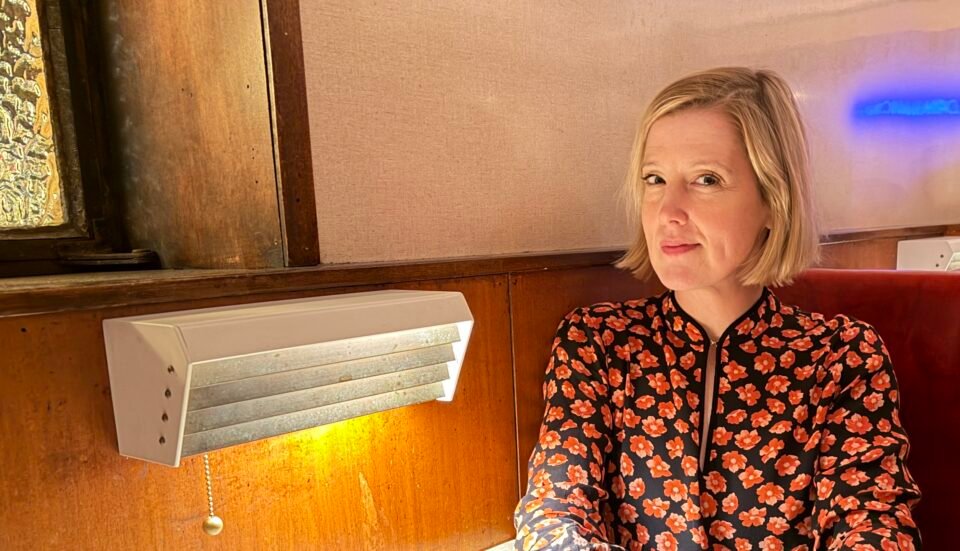
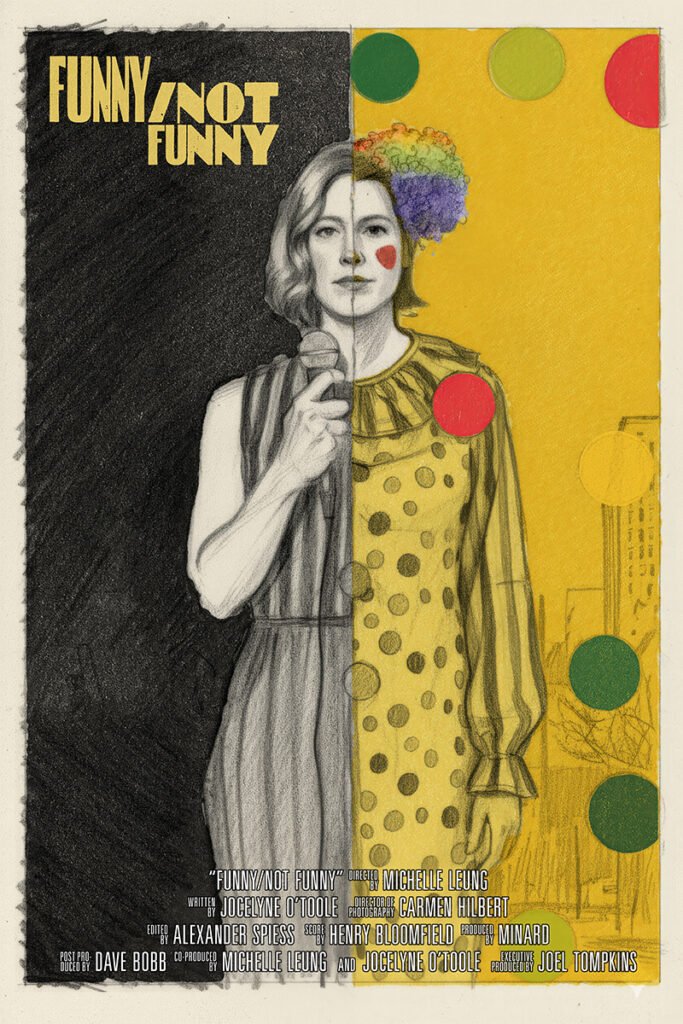
Rosie is in the middle of getting tossed out of a New York City open mic on her ass when the news hits: her mother is dead. Then a delivery turns up carrying her mother’s remains, and Rosie decides the only way to kill the suffocating weight in her chest is to dump the box and be done with it.
That ruthless, erratic errand gives director Jocelyne O’Toole’s Funny/Not Funny the green light to tear into the absurd, brutal reality of grief when life hits you sideways.
The concept was forged when O’Toole picked up her own mother’s ashes and was caught off guard by the sheer, heavy mass of the container. Eight years of grinding, writing, and throwing punches at the script developed alongside the late Shawn Regruto led to a story she stepped up to star in herself.
In this interview, O’Toole breaks down how processing her mother’s death reshaped the screenplay, what taking on Rosie’s fight allowed her to leave in the dust, and why the film’s funniest beats are the ones that make you squirm in your seat.
- Jocelyne, your background spans acting, writing and music. What first drew you to screenwriting, and what does it allow you to express that your other creative pursuits do differently?
Jocelyne: I have always used writing as a way to get through challenging situations. I have been journaling for as long as I can remember. It has always been a way to get it all out. Sometimes in the middle of dumping stories emerge. I love music and I love acting. It asks you to put yourself in the circumstances of what another writer or composer has created. I was very shy as a kid, so connecting to those kind of given circumstances helped me overcome my shyness. But as I got older I found that I wanted to tell my own stoies. I wanted to be able to share my experiences through my specific lens and that meant I had to write them.
- You described your new short film Funny/Not Funny; as a comedic love letter to your mother and Shawn Regruto. What was the first idea or image that helped you begin turning your grief into a story?
Jocelyne: The idea came from an experience I had after my mother was cremated. I was just so shocked at how heavy a box of ashes is and all of the bone debris that our bodies turn into when cremated. I was fixated on the image of a person picking up their mother’s ashes for many of the drafts of this script, but ultimately I had to let that go, too. I felt it was stronger to receive something from your dead mother than having to actually pick up your dead mother.
- How did the screenplay change as your own relationship with grief evolved over the 8 years that it took you to finish it?
Jocelyne: When I starting writing this piece, I was so angry that my mom didn’t fight harder to stay alive. She and I spoke every day before she got sick. And I really felt like I needed her help to naviagate all of life’s difficulties. She knew me the best and losing the person who had the best advice for me was unfathomable. I tried at one point to see if my dad would be a good substitute for my daily calls. Unforunately, he doesn’t like to talk. Coming to term with the fact that she fought as hard as she could, which took me years, I was finally able to work out the problems of the script, most notably how it’s still possible to make amends with loved ones even after they’ve passed. And as much as I miss her, I know that I stil have her nuggets of wisdom with me.
- There is always that challenge when drawing from something so personal. How did you decide which of your experiences you can share with the world in this screenplay?
Jocelyne: I just wanted to share that everyone’s unorthodox feelings of grief are valid. Though those were personal they also felt universal. None of the things that happened to Rosie ever happened to me. If my mom had sent me a Rumba, I probably would have cherished it forever and made into a shrine.
- Also, how did you carry your shared intentions into conversations with the director Michelle Leung who ultimately brought it to the screen?
Jocelyne: Michele and I had known each other for a while in the NYC Writer’s Group before we worked together on this project. I knew she was a talented director/producer and she has great taste. She heard and gave notes in the group on multple early drafts so was part of the process of getting the script to it’s final state. Also as a co-producer she was part of all the pre-production meetings. We had many conversations on what I hoped it would look and feel like to get on the same page. I’m grateful to have had her on this project.
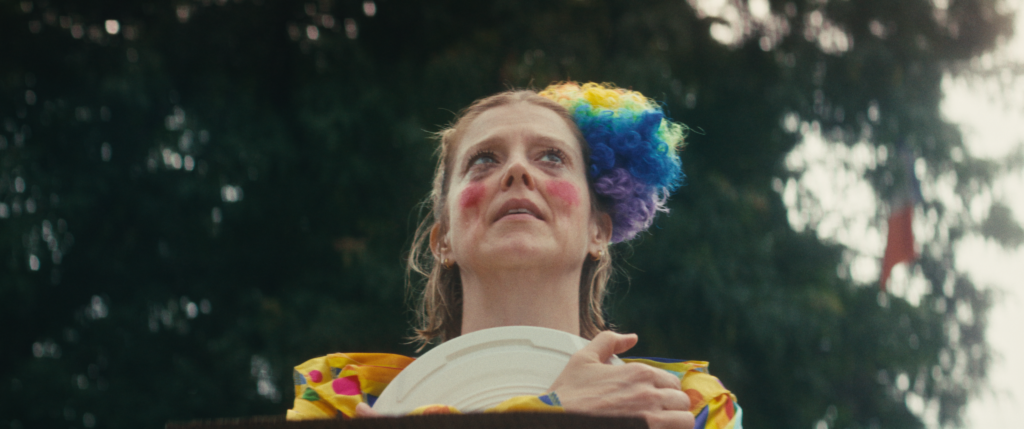
- Going into Funny/Not Funny was there anything specific that you learnt from making Eloise’s Tree; that helped or influenced your choices as a producer?
Jocelyne: Yes, I learned to prepare for everything falling apart right before the shoot but to trust that then it all will magically come back together. For Eloise’s tree, we lost the Christmas Tree Farm locataion days before we were going to shoot there because the farm was afraid that we would cut down trees. It all worked out but I did have to constantly remind myself of that during pre-production of Funny/Not Funny. Especially because locations were also a challenge for this production. The shoot could only be three days and in a row so we had to find six distinct locations that were all in very close proximity one another.
- How important was it for you to also play Rosie yourself? Looking back, would you have done anything differently?
Jocelyne: It was very important for me to play Rosie to create closure for this incredibly challenging period of my life. I don’t think I would have been able to fully grasp the magnitude of losing my mom otherwise. When writing it, I needed to write bad draft after bad draft to discover the feelings which by acting the role allowed for me to let them go. If I had given the role to someone else, I don’t think I would feel as much relief and peace from losing her. I don’t think I would have done anything differently because although mistakes were made, they have given me the knowledge on how to do it better next time.
- How was the casting process for the other characters in the film like, and what did finding those performers change or contribute to the film’s narrative?
Jocelyne: As I was writing the film, actor friends of mine kept popping up in my head. So when it came time to cast, I was hoping those actors would say yes when those offers were made. Luckily, every single one of them did say yes. For the other roles, we posted on Breakdown Services and received some really funny tapes. It was so cool to see how each actor brought their lives to the script. When we were on set, we did ask the actors to improv at points, and some of the lines that popped up are in the finished film because they were so brillant! The actors brought so much humor to the words on the page and their uniquenesses accentuated the zaniness of the world.
- After its SOHO International Film Festival premiere, what audience responses have stayed with you, and what do you hope Rosie’s story continues to make room for?
Jocelyne: The moderator of the Q&A after the premiere, Ben Feldman, said, “I’m still flabergasted. So much of it is not funny. So much of it is funny, because it’s not funny. Like I was cracking up at some of the “not funny” things. And some of it’s sad, but about comedy. So the whole dichotomy, the push/pull of that, was I thought brilliant.” I hope that this story reminds people to have whatever feelings they are having at impressionable moments of their lives, and know that it’s okay. Society conditions us to behave in certain ways. But when we aren’t behaving in those ways, it can feel very unsettling. I hope that people can watch this film and feel more comfortable with their processes as they go through life.
- Lastly, what’s next for you as a screenwriter? Should we expect a specific story or subject matter in your next project?
Jocelyne: I’m currently working on a feature film. It’s a different group of characters but I think the theme of having unwanted feelings and not fitting into what society deems appropriate will be something I will be unpacking for the rest of my life.
The real gut-check in this interview comes when O’Toole admits what she would’ve done with the cargo Rosie is so hell-bent on ditching. She would’ve locked it down forever, she says, and built a shrine around it.
There’s a dry laugh in that answer, but there’s real grit beneath both extremes. When someone goes down, an everyday object can become a weaponised reminder you can’t stand to look at, or the one piece of terrain you refuse to surrender.
After spending years fighting through her own rage and earning some peace by stepping into Rosie’s boots, O’Toole wants audiences to stop apologising for whatever raw emotions surface when the dust settles.
It’s a solid, straight-shooting verdict for a film that dares you to laugh right when you’re testing whether it’s safe to drop your guard.